| Workflow Orchestration |
Purpose-built ML pipeline orchestration with pluggable backends — Airflow, Kubeflow, Kubernetes, and more
|
First-class DAG pipelines built from versioned components with UI, CLI, and SDK authoring plus built-in scheduling within Azure
|
| Integration Flexibility |
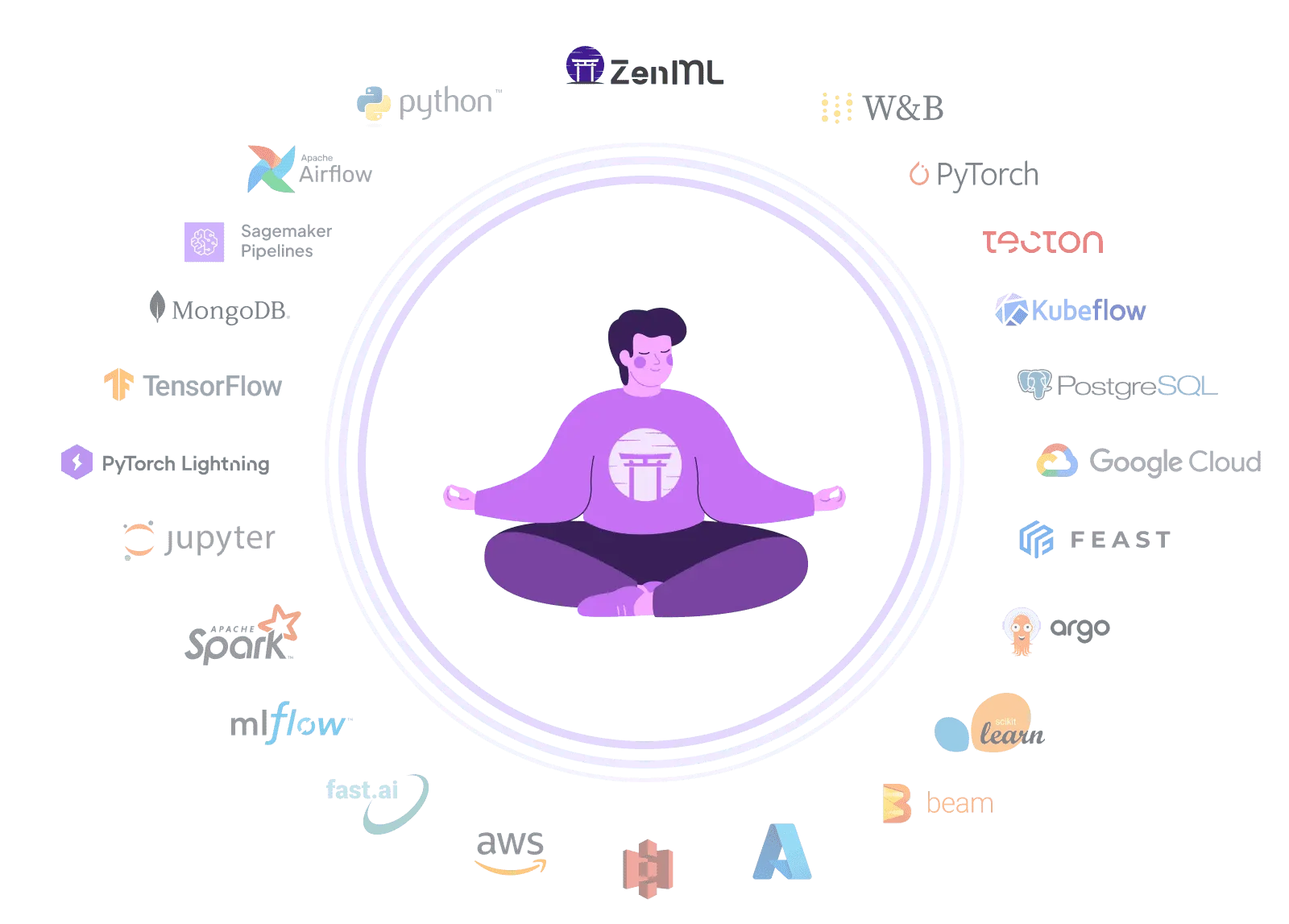
Composable stack with 50+ MLOps integrations — swap orchestrators, trackers, and deployers without code changes
|
Integrates well with Azure-native services and supports MLflow, but not built as a neutral integration hub for non-Azure tools
|
| Vendor Lock-In |
Open-source Python pipelines run anywhere — switch clouds, orchestrators, or tools without rewriting code
|
Fundamentally an Azure service — Arc-enabled K8s extends compute reach but governance and asset control remain tied to Azure workspaces
|
| Setup Complexity |
pip install zenml — start building pipelines in minutes with zero infrastructure, scale when ready
|
Initial setup requires workspace provisioning, IAM/RBAC, networking, and dependent Azure services like Storage, ACR, and Key Vault
|
| Learning Curve |
Python-native API with decorators — familiar to any ML engineer or data scientist who writes Python
|
Broad concept set (assets, resources, components, jobs, endpoints, registries) plus v1/v2 ecosystem fragmentation slows time-to-productivity
|
| Scalability |
Delegates compute to scalable backends — Kubernetes, Spark, cloud ML services — for unlimited horizontal scaling
|
Enterprise-scale managed training and inference on Azure compute, plus hybrid Kubernetes compute targets for large regulated deployments
|
| Cost Model |
Open-source core is free — pay only for your own infrastructure, with optional managed cloud for enterprise features
|
No separate platform fee, but total cost includes compute plus multiple Azure services (Storage, ACR, Key Vault, monitoring) that can be hard to predict
|
| Collaboration |
Code-native collaboration through Git, CI/CD, and code review — ZenML Pro adds RBAC, workspaces, and team dashboards
|
Workspaces, registries, and Azure RBAC make collaboration first-class — assets can be centrally managed and replicated across regions
|
| ML Frameworks |
Use any Python ML framework — TensorFlow, PyTorch, scikit-learn, XGBoost, LightGBM — with native materializers and tracking
|
Supports broad ML/DL workflows including no-code AutoML options and arbitrary training routines packaged as components or jobs
|
| Monitoring |
Integrates Evidently, WhyLogs, and other monitoring tools as stack components for automated drift detection and alerting
|
Deep Azure Monitor integration for endpoint metrics and logs, plus model monitoring with data drift signals and alerting via Event Grid
|
| Governance |
ZenML Pro provides RBAC, SSO, workspaces, and audit trails — self-hosted option keeps all data in your own infrastructure
|
Inherits Azure's enterprise governance model with RBAC, managed identities, registries with fine-grained permissions, and centralized asset management
|
| Experiment Tracking |
Native metadata tracking plus seamless integration with MLflow, Weights & Biases, Neptune, and Comet for rich experiment comparison
|
MLflow-compatible workspaces with automatic job metadata tracking — Azure ML recommends MLflow for metrics and params logging
|
| Reproducibility |
Automatic artifact versioning, code-to-Git linking, and containerized execution guarantee reproducible pipeline runs
|
Jobs automatically track code, environment, and inputs/outputs — versioned components and registries enable durable asset reuse across workspaces
|
| Auto-Retraining |
Schedule pipelines via any orchestrator or use ZenML Pro event triggers for drift-based automated retraining workflows
|
Supports scheduling pipeline jobs for routine retraining via UI, CLI, and SDK — though v2 schedules do not support event-based triggers
|